

Over the past decade, green finance has developed as an important tool for sustainable economic development, addressing global environmental issues such as climate change, biodiversity loss, and resource depletion (UNEP, 2016; OECD, 2017). Green finance is the term used to describe financial activities that support environmentally sustainable projects, such as renewable energy, energy efficiency, sustainable agriculture, and low-carbon technologies. Green finance plays a key role in the long-term economic sustainability challenge and helps in the global sustainability agendas by redirecting capital towards sustainable investment such as the Sustainable Development Goals (SDGs) and the Paris Agreement (UNFCCC, 2015).
Although green finance is increasingly becoming a global priority, its development and implementation remain inconsistent; especially in emerging and resource-dependent economies (World Bank, 2020). Previous studies indicate that the effectiveness of green finance policies largely depends on regulatory clarity and institutional capacity, particularly in emerging economies (Zhang et al., 2021). This includes structural barriers like weak regulatory frameworks, little market infrastructure, lack of financial literacy, and high perceived investment risk, which often limit green financial instruments (OECD, 2020; Taghizadeh-Hesary & Yoshino, 2019). Azerbaijan is a relevant case as an oil and gas-dominated economy. Although recent national strategies have focused on economic diversification and sustainability, integrating the green finance application into financial markets and everyday financial behavior is still nascent (ADB, 2021). Financial institutions often perceive green investments as riskier due to long payback periods and uncertainty, which limits market participation (D’Orazio & Popoyan, 2019).
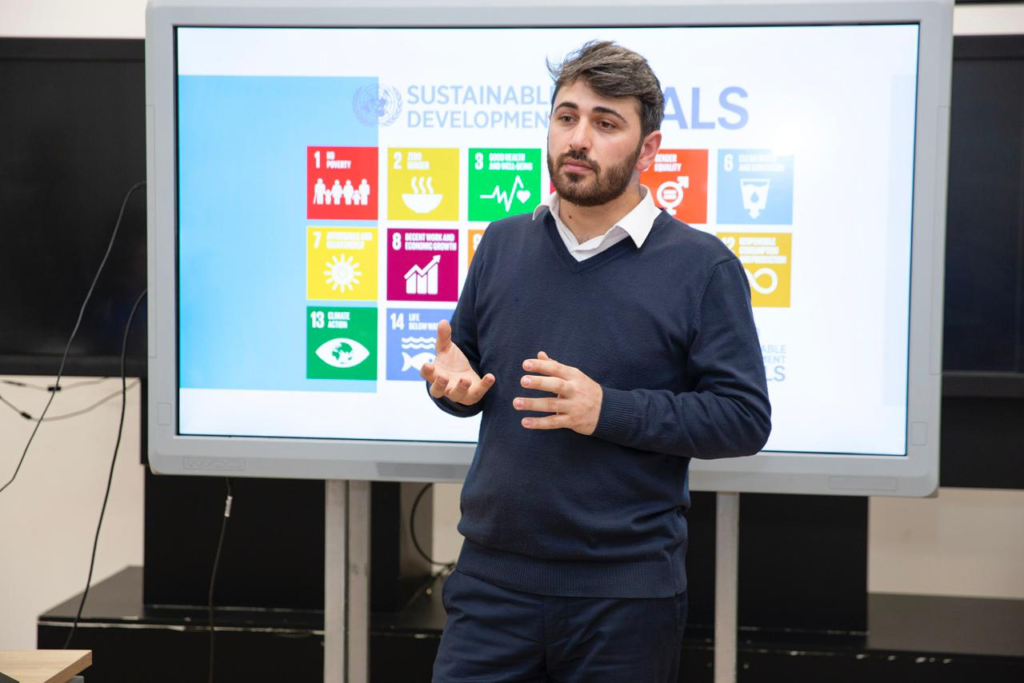
 Ulvi Mammadov, researcher
Here, gaining knowledge on public understanding, perceptions of, and attitudes towards green finance is necessary in order to design policies and develop markets that are effective. Low awareness and limited understanding among consumers substantially decrease demand for green financial products according to previous work (Liu et al., 2022; Sachs et al., 2019). Young people are especially influential in developing financial behaviors of the future and promoting sustainable transitions, owing to their higher acceptance of innovatory financial products and sustainable practices (UNDP, 2020). It is the basis of this study to provide an empirical examination of the youth knowledge and perception of green finance of Azerbaijan by means of survey data of 242 respondents. The study endeavors to provide evidence-based guidance for policymakers, financial institutions, and educators to promote the growth of green finance in Azerbaijan, exploring awareness levels, perceived prestige, willingness to use green financial products, and perceived barriers.
By employing a quantitative methodology involving a structured survey, this study takes an empirical look into the knowledge, perception and behavioral intentions of young people regarding green finance in Azerbaijan. Survey methods are most frequently used in sustainability and green finance research since they allow scholars to measure attitudes, awareness levels and preferences in general across a relatively large number of samples in a standardized fashion (Hair et al., 2019). This research is exploratory in nature and aims not to infer causal relationships; it seeks out dominant trends and barriers.
Based on data collected from 242 respondents using an online questionnaire, the empirical analysis was undertaken. The survey was conducted on a voluntary and anonymous basis. It’s intentional as we focus on youth with a key population that will come to influence future financial behaviors and assist in the sustainable economic transition. This would be similar sampling methods also frequently used when studying the generalist sampling strategies to determine public opinion about sustainable finance and environmental responsible practices (Field, 2018).
 UNDP, Photo from “Spearheading innovative “green” financing – for sustainable modernization” article
The empirical analysis is supported with a structured questionnaire that is designed to measure the objective and subjective aspects of youth participation in green finance in Azerbaijan. The questionnaire comprises seven major sections including demographic characteristics (age, gender, education, employment status, and income), general financial behavior and literacy, awareness and knowledge of green finance concepts, individual perceptions and psychological attitudes, social influence factors, behavioral intentions, and an open-ended item to explore perceived barriers to the development of green finance in the country. The Likert-type statements (1 = strongly disagree, 5 = strongly agree) are used to measure quantitative attitudes, trust, risk perception, environmental responsibility, and adoption intentions, while the open-ended responses provide qualitative insights into structural, institutional, and informational constraints. This mixed-question design enables a full statistical assessment of the intersection of demographics, cognition, and social factors to jointly determine youth perceptions and acceptance of green finance instruments. Table 1 presents the general structure of the questionnaire used in the study.
Table 1. Structure of the questionnaire
| Section | Content |
| A | Socio-demographic characteristics |
| B | Awareness and understanding of green finance |
| C | Social and media influence on financial behavior |
| D | Behavioral intentions toward green finance |
| E | Open-ended question on development barriers |
Quantitative data were analyzed using descriptive statistical techniques, such as frequency and percentage analysis. Descriptive statistics are well suited for exploratory research designs focused on summarizing patterns and tendencies in participants’ responses (Field, 2018). Responses on the Likert scale were pooled to determine overall agreement with and neutrality toward statements pertaining to green finance. Likert-scale responses were interpreted using a five-point agreement framework to ensure clarity and consistency of the findings. A score of 1 indicates strong disagreement, 2 represents disagreement, 3 reflects a neutral position (neither agree nor disagree), 4 corresponds to agreement, and 5 denotes strong agreement with the given statement. This standardized interpretation allows for a consistent comparison of respondents’ attitudes, perceptions, and behavioral intentions toward green finance.
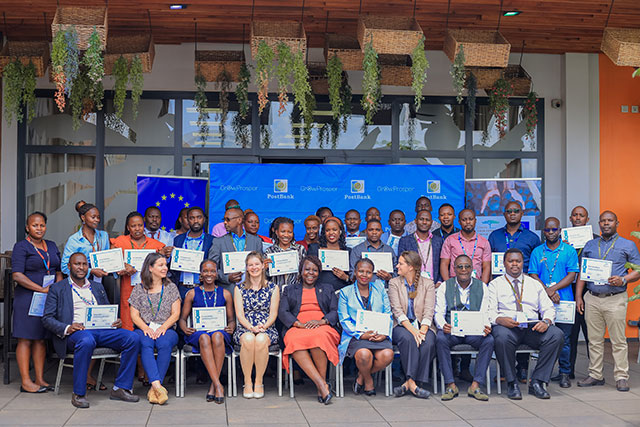 PostBank Champions Green Finance, https://www.radiosapientia.com/
Besides quantitative methods, the responses to the open-ended question on barriers to the development of green finance in Azerbaijan were also assessed by thematic analysis. This approach helps to identify recurring patterns and dominant themes within qualitative data (Braun & Clarke, 2006). This analysis found several frequently mentioned barriers: low public awareness, insufficient regulatory and institutional frameworks, limited financial incentives, and concerns about transparency and greenwashing. Ethical considerations were carefully observed throughout the research process. Participants were informed that the survey was conducted for academic purposes only, no personal identifying information was collected, and all responses were treated confidentially. These practices are consistent with standard ethical guidelines for survey-based research (Hair et al., 2019).
This section presents the empirical results of the survey conducted among 242 respondents in Azerbaijan. The findings are reported using descriptive statistics, mainly frequencies and percentages, in order to reflect respondents’ demographic characteristics, financial behavior, awareness, perceptions, social influences, and behavioral intentions related to green finance. In accordance with the methodological approach, the results are presented objectively, without interpretation or analytical commentary.
The demographic structure of the sample indicates a predominantly young respondent group. Individuals aged 18–22 represent the largest share of participants (67%), followed by those aged 23–27 (17%), 28–31 (8%), and 32–35 (7%). In terms of gender, 60% of respondents are female and 40% are male. Educational attainment is largely concentrated at the undergraduate level, with 69% holding a bachelor’s degree. This is followed by vocational education (13%), master’s degree holders (12%), respondents with secondary education (4%), and doctoral-level education (2%). Regarding current status, the majority of respondents are students (58%), while 20% are employed, 15% both work and study, and 7% are unemployed. Income distribution reflects this structure, as approximately 57% of respondents report having no regular income. Among those who do report income, most fall within the lower- and middle-income brackets, while a smaller proportion report earning above 1500 AZN or prefer not to disclose their income.
 UNDP, photo from “New Online Course Unlocks the Essentials of Climate Finance” article
With respect to financial behavior, the majority of respondents (80%) report using at least one banking product, whereas 20% indicate that they do not use banking services. The most commonly used financial products are bank cards or current accounts (58%), followed by credit products (21%), deposits (6%), and investment products (4%). At the same time, 11% of respondents report not using any financial products. Self-assessed financial literacy levels are generally low to moderate, with most respondents rating their knowledge at levels 1 or 2 on a five-point scale.
Awareness of green finance is limited among respondents. Only 26% state that they have previously heard of the term “green finance,” while 74% report no prior familiarity with the concept. When asked about the meaning of green finance, more than half of the respondents (54%) associate it with financing environmental projects, while 27% link it to sustainable and responsible investments. A further 16% indicate that they do not know what green finance represents, and a small share perceive it mainly as a marketing concept. Awareness of specific green finance instruments is also low, as 19% report having heard of green banking, 14% of green credit, 8% of green bonds, and 7% of ESG investments, whereas more than half of the respondents (52%) indicate that they are unfamiliar with all of these terms. Self-rated knowledge of green finance products is predominantly low, with 42.6% rating their knowledge at the lowest level and 35.5% at the second-lowest level.
Prior empirical evidence suggests that environmentally oriented financial institutions are not necessarily exposed to higher risks and may benefit from enhanced trust and reputation effects (Gangi et al., 2019). Results derived from Likert-scale statements show that respondents generally express moderate attitudes toward green finance. A large proportion of participants neither agree nor disagree with statements related to the effectiveness and credibility of green finance products, indicating a notable level of uncertainty. At the same time, a considerable share of respondents agree or strongly agree that green finance can contribute to environmental protection and that ecological responsibility plays an important role in their financial decision-making. Responses to statements addressing greenwashing reveal the presence of skepticism regarding the actual environmental impact of green financial products.
Findings related to social influence demonstrate mixed outcomes. While some respondents indicate that the opinions of family members, friends, and society influence their financial choices, a substantial proportion remain neutral or disagree with such statements. Media influence appears to be moderate, as many respondents neither strongly endorse nor strongly reject the role of social and traditional media in increasing their interest in green finance–related topics. Behavioral intention results suggest a generally positive yet cautious orientation toward the future adoption of green finance products. A relatively high proportion of respondents agree or strongly agree that they would consider using green financial products in the future and would prefer them over conventional financial products when conditions are equal. However, willingness to choose green financial products when they involve higher costs is more restrained, with neutrality and disagreement remaining common. A clear pattern emerges regarding the importance of information, as the majority of respondents agree or strongly agree that increased information and communication from banks and government institutions would significantly enhance their interest in green finance products.
 https://www.un.org/en/climatechange/why-finance-climate-action
The findings presented in this study give an empirical estimate of young people’s knowledge, attitudes and behaviours of green finance in Azerbaijan. The findings highlight an important discrepancy between positive environmental attitudes and the practical knowledge and use of green financial products. While the respondents overwhelmingly indicate a high degree of ecological stewardship and willingness to think about green financial choices in the future, a lack of information, low financial literacy, and concerns about credibility, namely greenwashing, remain barriers to greater expansion. Social influence and media exposure appear to moderately affect interest levels, whereas trust in financial institutions continues to be an important driver of acceptance. To conclude, the results show that the regulatory model and institutional mechanisms need to be improved and further strengthened and transparency and information is important; more specialized education and promotion provided by local and international banks and public bodies is required for a better understanding. Enhancing information sharing and confidence in green finance tools may be an important way forward in supporting the development of sustainable finance and to support the shift of Azerbaijan to a more sustainable economic model.
Article: https://www.aem.az/en/an-empirical-analysis-of-youth-knowledge-and-perceptions-of-green-finance-evidence-from-azerbaijan
https://doi.org/10.36719/3104-4727/5/49-53
References
- Asian Development Bank. (2021). Azerbaijan: Country partnership strategy, 2019–2023. https://www.adb.org/documents/azerbaijan-country-partnership-strategy-2019-2023
- Braun, V., & Clarke, V. (2006). Using thematic analysis in psychology. Qualitative Research in Psychology, 3(2), 77–101. https://doi.org/10.1191/1478088706qp063oa
- D’Orazio, P., & Popoyan, L. (2019). Fostering green investments and tackling climate-related financial risks: Which role for macroprudential policies? Ecological Economics, 160, 25–37.
https://doi.org/10.1016/j.ecolecon.2019.02.018 - Field, A. (2018). Discovering statistics using IBM SPSS Statistics (5th ed.). SAGE Publications.
- Gangi, F., Meles, A., D’Angelo, E., & Daniele, L. M. (2019). Sustainable development and corporate governance in the financial system: Are environmentally friendly banks less risky? Corporate Social Responsibility and Environmental Management, 26(3), 529–547.
https://doi.org/10.1002/csr.1709 - Hair, J. F., Black, W. C., Babin, B. J., & Anderson, R. E. (2019). Multivariate data analysis (8th ed.). Cengage Learning.
- Liu, N., Liu, C., Da, B., Zhang, T., & Guan, F. (2022). Dependence on green finance and its impact on environmental performance: Evidence from emerging economies. Environmental Science and Pollution Research, 29(3), 3727–3741. https://doi.org/10.1007/s11356-021-16169-9
- Organisation for Economic Co-operation and Development. (2017). Green finance and investment: Mobilising resources for sustainable development. OECD Publishing. https://doi.org/10.1787/9789264272323-en
- Organisation for Economic Co-operation and Development. (2020). Developing sustainable finance definitions and taxonomies. OECD Publishing. https://doi.org/10.1787/134a2dbe-en
- Sachs, J. D., Schmidt-Traub, G., Kroll, C., Lafortune, G., & Fuller, G. (2019). Sustainable development report 2019. Bertelsmann Stiftung & Sustainable Development Solutions Network.
- Taghizadeh-Hesary, F., & Yoshino, N. (2019). The way to induce private participation in green finance and investment. Finance Research Letters, 31, 98–103. https://doi.org/10.1016/j.frl.2019.04.016
- United Nations Development Programme. (2020). Youth and the Sustainable Development Goals. United Nations Development Programme.
- United Nations Environment Programme Finance Initiative. (2016). Global guide to green finance. United Nations Environment Programme.
- United Nations Framework Convention on Climate Change. (2015). Paris Agreement. https://unfccc.int/process-and-meetings/the-paris-agreement/the-paris-agreement
- World Bank. (2020). Green finance for sustainable development. World Bank Group.
- Zhang, B., Yang, Y., & Bi, J. (2021). Tracking the implementation of green finance policies in China: Evidence from green credit. Journal of Cleaner Production, 290, 125–134.
https://doi.org/10.1016/j.jclepro.2021.125134